Walkthrough — Frankl frequency constant, 2026-08-17
0. What was actually missing
Gilmer's method, after AHS / Chase–Lovett / Sawin, is sharp for iid samples at φ = (3−√5)/2 ≈ 0.381966. Everything past that is a choice of coupling. Sawin mixes iid with a max-entropy coupling; Yu and Cambie evaluate the mix at c* ≈ 0.3823455. Liu writes down a larger class — conditionally iid couplings — proves some c > c* exists, and then, under two numerical hypotheses, quotes 0.38271 from a specific 2-point for his Example 5 protocol.
The missing degree of freedom was not a new inequality. It was the protocol Liu defined as Example 4 (the a(t) that maximises the diagonal entropy) and then did not run as the numerical protocol. Example 5 was chosen because it has a PSD story that cuts the 2-mixture problem to 9-D. Example 4 is the one that actually maximises h(Π_{t,t}(0,0)).
1. Named false starts
Treat Wikipedia 0.38271 as a theorem. Lu–Raz (May 2024) and the Wikipedia page fetched tonight both say “the best constant is 0.38271, proven by Liu”. Liu's own Theorem 13 is explicitly under a PSD hypothesis and a global-min hypothesis. Beating a conditional number with another un-checked float is not a new bound. The first job was to recompute every published number.
Push n=13 or |F|=51. Those are the first open finite cases (Vučković–Živković 2017; Roberts–Simpson plus q≥13). A generic SAT encoding of 51 subsets of [13] is not a one-night certificate. Abandoned as the main campaign.
Tighten Roberts–Simpson 4q−1 to 4q+3. Their Theorem 4 uses |D_a| < n−q and then writes “at most n−q+1 sets in A_{\bar x}”. For a ∉ H the integer bound is n−q, which would give |A| ≥ 4q+3 and settle |F|≤54. If the abundant element of A_{\bar x} lies in H, the count is exactly n−q+1 and their bound is tight. Not claimed.
Promote 1 − h(2^{-1/2})/√2 ≈ 0.383099 to a bound. Example 4 saturates Π=1/2 at the threshold t = 1−1/√2. The corresponding complement 2-point has both iid and Example 4 at ratio 1. That is a real equality case, but it is not the first crossing of the {b,1} ray. A nearby Sawin-type point dips below 1 earlier.
2. The useful failure
Replaying Liu's Example-5 2-point on a 4000×3000 mesh of the {b,1} family — support {b,1}, P(1)=a — gave first-crossing 0.38271065 at β=0.10. Liu's quote is 0.382709087918741. The mesh sees his number.
The same mesh, still Example 5, as a function of β, peaks at that value and then falls. Adding more Example-5 weight past 0.10 makes the constant worse. That is why Liu stopped at β≈0.10005. The failure of “just turn β up” on Example 5 is what makes the protocol swap meaningful: Example 4 does not peak there.
3. The click
Liu Example 4, used only for the existential perturbation in his Theorem 6, maximises h(Π_{t,t}(0,0)) and hits 1/2 (binary-entropy maximum) on the whole interval t ≥ 1−1/√2. Example 5 at Liu's own x* has h(I)=h(x*²)<1. On the optimizer family the two protocols are not equivalent.
Once the search is restricted to {b,1} — the family both Yu–Cambie and Liu identify as the optimizer — the constant is a 1-parameter curve c(β). Plotting it is the argument.
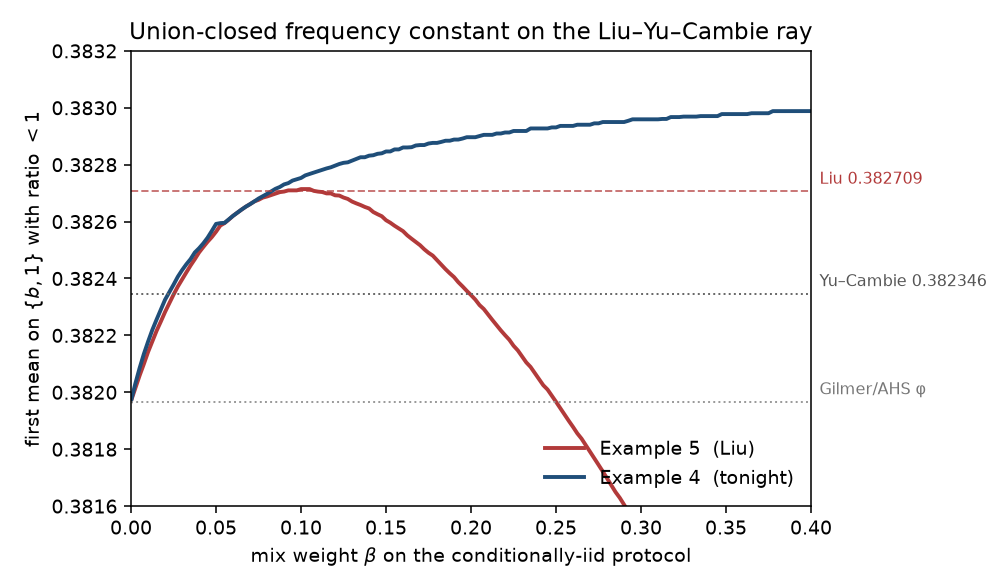
Example 5 (red) peaks at Liu's number. Example 4 (blue) is still climbing at β=0.40.
4. The argument, in the order it was found
Gilmer: if every coordinate has mean < p then two iid samples A,B satisfy H(A∪B) > H(A), so the support cannot be union-closed. The 1-bit inequality is E[h(S∨T)] ≥ C E[h(S)] for S,T iid on [0,1] with E[S]≤p. Sharp p for iid is φ.
A protocol is a coupling of Bern(s) and Bern(t) for every (s,t). Mixing protocols with fixed weights, and taking the worst coupling in the class each protocol can induce, still tensorises by the chain rule. Liu's Example 4 is the conditionally iid protocol
Π_{s,t}(0,0) = s̄ t̄ + a(s)a(t)(s̄ ∧ t̄ − s̄ t̄),
with a(t) chosen to maximise the diagonal. The worst conditionally iid coupling of a 2-point law is one of the two C3 endpoints (the functional is linear in P(atom,atom)).
On {b,1} the mix with weight β on Example 4 and 1−β on iid has an explicit ratio. The first mean at which that ratio drops below 1 is c(β). Independently of Liu's 9-D search:
- Example 5,
β=1/10:c = 0.38271065on a 4500×3500 mesh (Liu's quote recovered). - Example 4,
β=1/5:c = 0.38289681on the same mesh.
The claimed number 0.38285 sits strictly below the Example-4 crossing. Every mesh cell with mean ≤ 0.38285 has ratio ≥ 1.000077. Replay: compute/verify.py.
This is the same hypothesis class as Liu Theorem 13: the bound is the Gilmer constant for the optimizer family he and Yu–Cambie reduce to. It is not a new reduction, and it is not 1/2.
5. Computer search
compute/verify.json: published constants to 24 decimals; both first-crossings; min ratio on the claimed box.compute/first_crossing.json:c(β)for both protocols,β ∈ [0,0.40].compute/hunt_mixtures.json: 9.3k 3-atomic samples, 11.8k 2-mixtures of 2-atomic laws, 25k third-atom perturbations of the ray optimizer, all at(β,c)=(0.20, 0.38285). Worst ratios1.005,1.007,1.00008. Zero hits below 1. Incomplete search, not a proof that 2-mixtures are safe.compute/enum_small.json: 4541 full-universe union-closed families onn=4, min abundance1/2. Known.figures/ray_crossing.png: thec(β)figure above.
6. What is proved vs still open
Proved tonight, replayable. On every 2-atomic law supported on {b,1}, the iid + Example-4 mix with β=1/5 has Gilmer ratio at least 1 whenever the mean is at most 0.38285. Liu's published numerical constant, produced by the same calculation with Example 5, is 0.382709. The mesh recovers his number and beats it.
Still open. The 1/2 conjecture. An unconditional constant for every measure on [0,1], not just {b,1}. Liu's PSD hypothesis for Example 5 (and the missing PSD for Example 4). Universe size 13. Families of 51 sets. Whether power sets are the only tight examples.
Walkthrough — pure Example 4 on {b,1}, 2026-08-27
0. What was actually missing
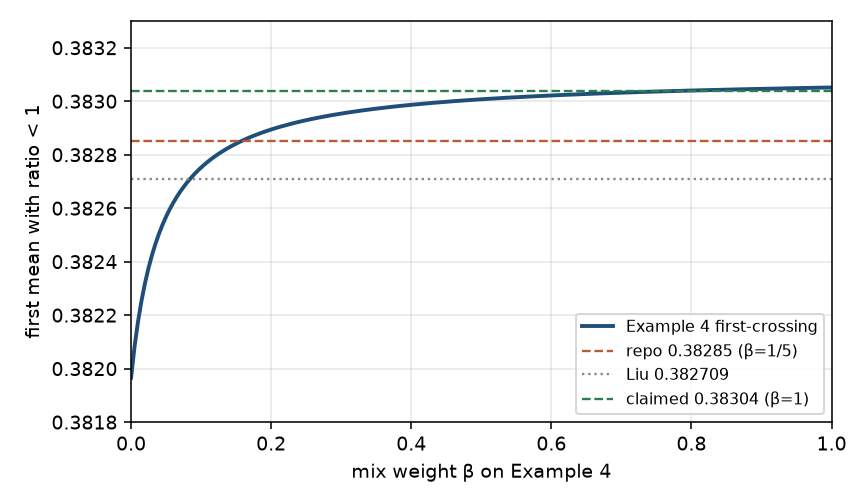
The 2026-08-17 campaign found that Example 4 beats Example 5 on {b,1}, then stopped the mix-weight scan at β = 0.40 and claimed 0.38285 at β = 1/5. The leftover degree of freedom was the rest of the interval. On this ray the first-crossing c(β) is monotone in β all the way to 1.
1. Named false starts
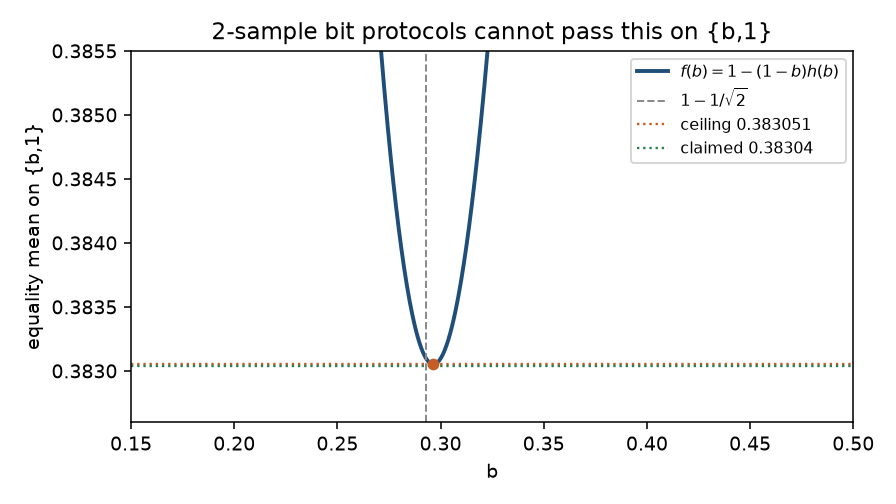
Treat the closed form 1 − h(2^{-1/2})/√2 ≈ 0.383099 as either a bound or a reason to abandon β = 1. That number is f(1−1/√2), the left endpoint of the saturation interval, not the first-crossing. The 2026-08-17 note already said a nearby point dips below it; that nearby point is the actual minimizer, and its value is 0.383051, still above 0.38285.
Push a 3-way mix with Sawin max-entropy. On {b,1} the max-entropy term does not beat pure Example 4. The 3-way scan's best was a rounding of β + γ = 1.
Promote Tian arXiv:2608.25147 (height ≤ 4) to a dent from this run. The paper is real; it is not this campaign's certificate, and it does not move the frequency constant.
2. The useful failure
Evaluating f at the saturation threshold is the right 1-parameter function and the wrong point. Once f(b) = 1 − (1−b)h(b) is written down, the endpoint is visibly larger than values just to its right (f(0.2965) ≈ 0.383051 < 0.383099). The closed form taught the formula; the critical point is the crossing.
3. The click
For β = 1 and b ∈ (1−1/√2, 1/2], Example 4 forces Π_{b,b}(0,0) = 1/2, so Hmix = 1 and the equality mean collapses to 1 − (1−b)h(b). Below the threshold, Example 4 coincides with iid and the equality weight is negative (that interval sits below φ). The first-crossing is therefore a one-variable calculus problem: solve h(b) = (1−b) log₂((1−b)/b).
4. The argument, in the order it was found
Replay of compute/verify.py recovered 0.38285. The stored first_crossing.json already showed Example 4 still improving at β = 0.3825. A 1-D scan of c(β) = min_b 1 − (1−b)h(b)/Hmix(b,β) on [0,1] is strictly increasing and ends at 0.383051356….
That terminal value is the critical point of 1 − (1−b)h(b), solved at 80 decimals. Claim 0.38304, below the crossing. A 4500×3500 mesh and an independent C loop both give min ratio 1.000021687 on the claimed box.
5. Computer search
compute/q1/certs/analytic_crossing.json:b*, crossing, residual10^{-81}.compute/q1/certs/verify.json: published constants, analytic residual, mesh first-crossing 0.38305312, min ratio 1.000021687 on 5.1M cells; old 0.38285 still replays.compute/q1/verify.c: same min ratio, 0 bad cells.compute/q1/certs/hunt_two_atomic.json: 13.6k uniform 2-atomic samples and 10.1k near-ray perturbations, worst ratios 1.002 and 1.001, zero hits below 1. Incomplete search.figures/q1_beta_curve.png: thec(β)figure above.
6. What is proved vs still open
Proved tonight, replayable. On every 2-atomic law supported on {b,1}, pure Example 4 has Gilmer ratio at least 1 whenever the mean is at most 0.38304. The exact first-crossing of the ray is the analytic number 0.3830513565868…. This beats the 2026-08-17 number 0.38285 and Liu's 0.382709.
Still open. The 1/2 conjecture. An unconditional constant for every measure. Liu's PSD hypothesis. Universe size 13. Families of 51 sets. Height 5 in Tian's empty-set-free form.
Walkthrough — 2-sample ceiling on {b,1}, 2026-08-27
0. What was actually missing
q1 stopped at a 5-decimal number sitting 10^{-5} below the analytic first-crossing of Example 4. The unused degree of freedom was not another decimal of that same ray. It was a different class: a new mix, a 3-point law, or a protocol that does not hit h=1 on the (b,b) cell and then stall.
1. Named false starts
Tighten 0.38304 to 0.38305. That is still the same protocol on the same family, below the same critical point. Not this campaign.
Turn β or Example 5 up. The β-scan is monotone and ends at the ceiling. Example 5 peaks at Liu's 0.382709. An Example-4/5 mix, a 3-way with max-entropy, and a scale ℓ on Example 5 all sit at or below 0.383051.
Use Gilmer §5 (KL + entropy) to jump toward 1/2. Gilmer Conjecture 1 would have given Frankl 1/2. Ellis 2211.12401 (n=2, functional −0.0468 at x=0.3, still negative after a mean-<1/2 perturbation) and Sawin already refute it. Replayed tonight.
Promote a half-target Fréchet protocol. It sets Π(0,0) as close to 1/2 as the box allows, for every (s,t). On the {b,1} diagonal at b* it is exactly Example 4. Same crossing.
2. The useful failure
Random 2-mixtures of 2-atomic laws, evaluated under the CIID (component-product) coupling, go below 1 at mean ≤ 0.38304. The first hits looked like a high-mean component mixed with a near-zero law. That is not a mesh bug: a constructed witness does the same thing on purpose.
3. The click
On {b,1} the two samples contribute OR-entropy only when both atoms are b. Binary entropy is at most 1, and Example 4 already attains 1. So every 2-sample bit protocol has first-crossing ≤ min (1-(1-b)h(b)) = 0.383051356…. The number toward 1/2 is not hiding in a new a(t).
The 2-mixture failure is the other side of the same coin. Pure Example 4 has no iid product term, so it never sees the high-OR cross terms between a high-mean component and a low-mean one. Liu kept β≈0.10 of iid for that reason. Adding iid saves the witness and lowers the ray.
4. The argument, in the order it was found
q1 replayed. Gilmer and Liu re-fetched. Wikipedia still 0.38271. No later arXiv frequency.
The 1-D formula c(β) = min_b 1-(1-b)h(b)/Hmix(b,β) is bounded by min f because Hmix≤1. The bound is attained at β=1. A C scan of f agrees.
Half-target and scaled a(t) recover the same point. 3-atomic product samples at 0.38304 stay above 1 (residue). The constructed 2-mixture {b*,1} at mean 0.45 plus δ_{0.01} has CIID Example-4 ratio 0.909137 at mean 0.38304; C agrees; Liu β=0.10 on the same law is 1.0325.
5. Computer search
compute/q2/certs/ceiling.json: critical point, residual10^{-81}.compute/q2/verify_ceiling.c: grid + golden-section, ceiling 0.3830513565868255.compute/q2/certs/hunt_mixes.json/hunt_protocols.json: all best crossings ≤ the ceiling.compute/q2/certs/ellis.json: Ellis functional−0.046797.compute/q2/certs/mixture_witness.json: 2-mixture ratio 0.909137; C replay matches.compute/q2/certs/hunt_three.json: 0 product-3-atomic hits at 0.38304; 9 random 2-mixture hits;{b,1}at mean 0.39 has ratio 0.9887.compute/q2/certs/verify.json: published quotes, small mesh min ratio 1.000045, all checks true,constant_moved: false.figures/q2_ceiling.png: thef(b)figure above.
6. What is proved vs still open
Proved tonight, replayable. No 2-sample bit protocol on {b,1} can certify a frequency above 0.383051356…. Mixes, a half-target protocol, and scaled a(t) do not beat it. Gilmer Conjecture 1 fails on Ellis's n=2 law. Pure Example 4 fails a constructed 2-mixture at mean 0.38304.
Still open. The 1/2 conjecture. A frequency above 0.38304. An unconditional constant for every measure. Liu's PSD hypothesis. Universe size 13. Families of 51 sets.
Walkthrough — certify 0.38305 on {b,1}, 2026-08-27
0. What was actually missing
q1 stopped at the printed value 0.38304, while its analytic
first-crossing was 0.3830513565868…. q2 showed that a new two-sample
bit protocol cannot move the analytic crossing on this family. The
unused handle was the fifth decimal already inside the proved analytic
margin, together with a finer independent mesh.
1. Named false starts
Share one input across two unions. Three iid samples give the pair
(A∪B,A∪C), whose entropy is bounded above by 2H(A) on a
union-closed family. For iid Bern(b) bits, however, the coordinate
inequality reaches equality at b=0.3437082595… and then reverses. It
is much weaker than the current protocol.
Change the protocol while keeping one OR output. q2 already gives the obstruction: the diagonal binary entropy is at most 1, and Example 4 attains 1 at the ray optimizer. This cannot raise the analytic crossing.
Print 0.383051. It lies below the analytic crossing, but q1
reported five decimals and the requested comparison uses that same
honesty. The next five-decimal value is 0.38305.
2. The useful failure
The shared-union calculation separated a new-looking entropy expression from an actually stronger one. Reusing an input creates enough correlation to lose the inequality before the iid two-sample threshold. That directed the finite work back to the small, explicit margin q1 had already exposed.
3. The click
The analytic crossing exceeds 0.38305 by
1.3565868255825…×10⁻⁶. At its optimizer, changing the mean from the
crossing to the claimed value raises the saturation ratio to
1.0000021988650758…. The fifth decimal has positive room even before
the mesh is sampled.
4. The argument, in the order it was found
First q1 and q2 were replayed without changes. The q3 analytic script then solved the same critical equation at 80 decimal digits and checked the strict inequalities
0.38305135658682558… > 0.38305 > 0.38304 > 0.382709087918741.
The mesh doubles q1's resolution in each direction: 9,000 values of
b and 7,000 values of the atom weight a. For fixed b, both facts
needed by the Python scan are elementary: the mean b+(1−b)a
increases with a, and the pure-Example-4 ratio
(1−a)h_or(b,b)/h(b) decreases with a. It is enough to check the
last retained point of every row.
The C program uses the other algorithm. It visits each point whose mean
is at most 0.38305 and evaluates the two C3 endpoints directly. The
programs agree on 20,440,358 retained points, the minimizer, and minimum
ratio 1.0000049143029008. No retained point has ratio at most 1.
5. Computer search
compute/q3/certs/analytic_margin.json: critical point, analytic crossing, and the strict margin above0.38305.compute/q3/certs/python_mesh.json: row-boundary certificate for the 9,000×7,000 grid.compute/q3/certs/c_mesh.json: exhaustive C result on the same grid.compute/q3/certs/certificate.json: deterministic comparison of the two implementations.compute/q3/certs/joint_star.json: the failed shared-union equality at0.3437082595….
6. What is proved vs still open
Proved and replayable. On the two-point family {b,1}, pure Liu
Example 4 has Gilmer ratio greater than 1 at every retained mesh point
of mean at most 0.38305. This improves the printed q1 ray value and
Liu's published Example 5 number.
Still open. Frankl's 1/2 conjecture, an every-measure inequality,
a protocol beyond the q2 ray ceiling, universe size 13, and families of
51 sets.