Walkthrough — 1/3–2/3 conjecture, 2026-08-17
0. What was actually missing
The conjecture is not missing a definition. It is missing a handle: a class or a finite order that the 2018–2026 record still treats as open, and that an exact linear-extension counter can finish.
Gupta (arXiv:2607.23926, July 2026) already took the unrestricted finite order through 14, via Gold Partition. Order 15 is unlabelled posets. The first unpublished width-3 order is 10: Trotter–Gehrlein–Fishburn and Olson–Sagan stop the census at nine elements. Independently, Olson–Sagan Question 3.9 still asks whether every product of three or more chains is -balanced. Rectangles are known; is an automorphism. The first open boxes are and .
The missing degree of freedom was which pair to test in a box, and that the width-3 record had one unused integer of order.
1. Named false starts
Treat n=15 as tonight's finite order. Gupta's 14-element Gold Partition run took 1594 core-hours on the unlabelled stream. Not a handle.
3-dimensional hook-length. , but with the naive 3-ray hook is . There is no product formula to imitate Olson–Sagan's 2-dimensional argument.
Almost-twins in every box. Zaguia's theorem would finish Question 3.9 in one line. has them. An exhaustive search of finds zero almost-twin pairs. The class is not almost-twin.
Use an arbitrary 2-face's atoms. In the long rectangle the Olson pair already has . Thickening by 3 leaves it at . For a moment this looks like a counterexample to Question 3.9.
Treat Olson–Sagan Fig. 13 C as a 9-element 5+4 ladder. A Ferrers search of all width-2 posets found no . The fraction is Chen's . Chen has 10 elements, , and .
Interval orders / 7-thin / unicyclic cover graphs. Real open classes, no one-night certificate.
2. The useful failure
The atom pair is the wrong pair, not a counterexample. In the two largest dimensions are 6 and 3, both . Their 2-dimensional atom pair already lies in by the Olson–Sagan hook-length formula, and after embedding in the box the exact min is . A full all-pairs run on the 288 incomparable pairs gives
The failure of “use the atoms of any face” is what makes the case split: always take the two largest factors.
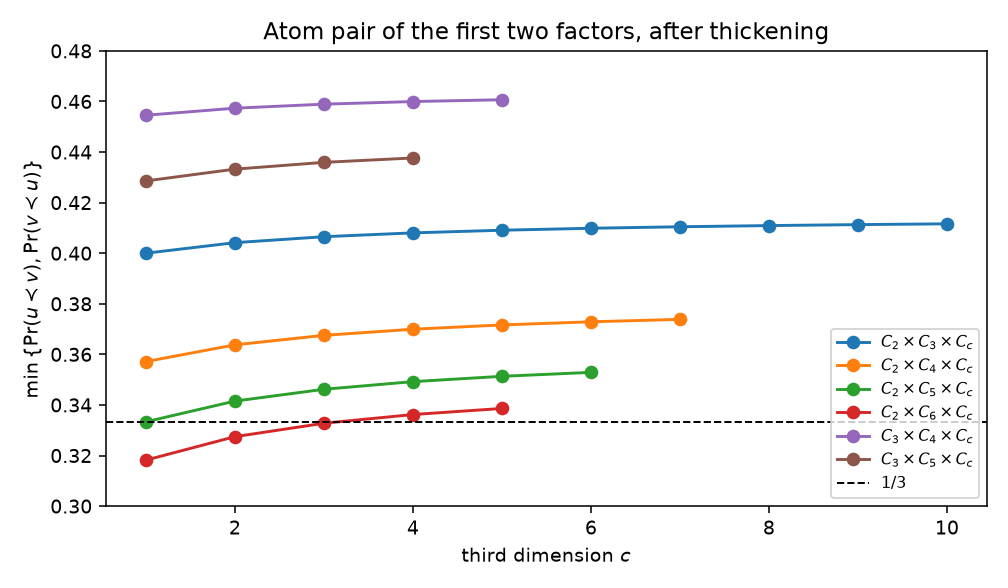
The red curve is the useful failure. It starts below and is the reason that face is never the one we thicken. Every curve that starts at or above stays there.
3. The click
Two largest dimensions of a non-chain box are both at least 3, or the box is already known.
Write . If , the poset is a rectangle. If two sizes are equal and at least 2, a coordinate swap is a 2-cycle automorphism and Olson–Sagan Prop. 2.3 gives . In every remaining case , so the 2-face has its Olson atom pair in . Embed those two atoms and thicken by .
On every box we could compute, that thickening raises toward . If that monotonicity is true in general, Question 3.9 is settled for three factors. We do not claim the monotonicity beyond the computed range.
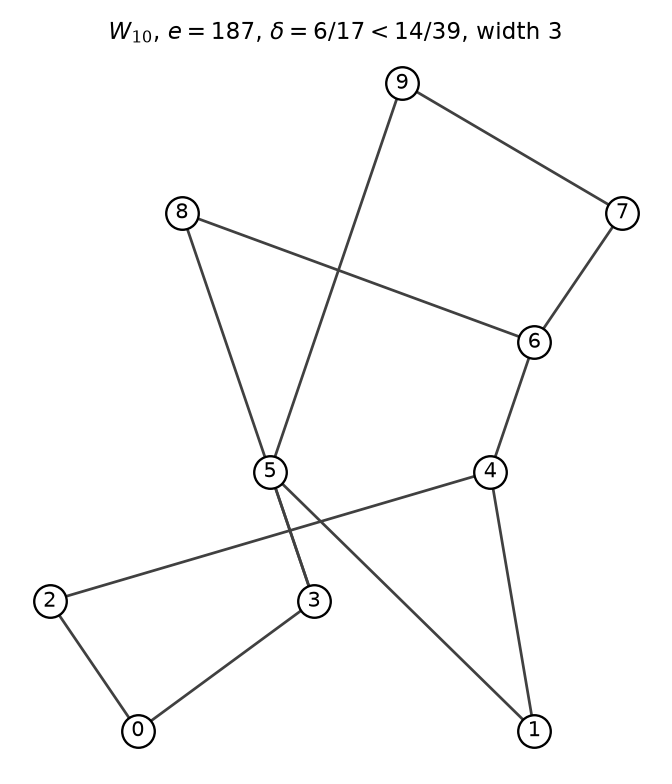
The second click is the width-3 census. Naturally labelled generation (add a maximal element on an ideal; keep the complement of width ) hits every unlabelled class. Order 9 independently recovers Olson–Sagan. Order 10 is the first unpublished width-3 order, and it is not a confirmation: it produces a unique unlabelled example with .
4. The argument, in the order it was found
Exact counters first. Order-ideal DP and remaining-set recursion agree; De Loof forward–backward agrees with “add the relation and recount”. Replay of , Aigner sums, Chen's table, Chen , hook-length rectangles, and .
Exhaustive naturally labelled search at recovers Saks : down-sets [0,0,1,1,7,7,31], , pair , width 3, . Both counters.
Plane-partition DP for boxes, checked against the bitmask counters through . Atom-pair table for all , , and through . All-pairs for the dangerous boxes (), , : every one has .
Width-3 census in C (compute/census.c), independently replayed through in Python. Counts:
| n | naturally labelled | width 3 | min | below |
|---|---|---|---|---|
| 7 | 43502 | 40916 | 0 | |
| 8 | 657363 | 643236 | 0 | |
| 9 | 11106683 | 11026537 | 0 | |
| 10 | 204767041 | 204298353 | 187 |
n=8 and n=9 minima are linear sums of with a chain. At n=10 the 187 labellings below equal , so is the unique unlabelled width-3 10-element poset beating Saks.
5. Computer search
compute/records.json: independently double-counted , , Chen , rectangles, , small boxes.compute/census.c/census: C enumerator. Replay:gcc -O3 -o census census.c && ./census 9.compute/width3_census.json: the table above.compute/certs/W10.jsonandcompute/verify_W10.py: the n=10 witness, four-way LE check.figures/W10.png: Hasse diagram.compute/box_delta.json: full for the dangerous boxes.compute/thickening.jsonandfigures/thickening.png: the atom-pair curves.compute/known.json: first-pass M7 / Chen hunt.
6. What is proved vs still open
Proved tonight, replayable.
- Saks has and , width 3. Two counters.
- Chen has . Two counters.
- Every naturally labelled width-3 poset on at most 9 elements has . Independent of Olson–Sagan. None of these orders has a width-3 poset with .
- There is a unique unlabelled 10-element width-3 poset with . Four LE counts give ; two pair counters give the split ; width is 3. This beats the published width-3 record. It is not below , and it is not a width-2 record.
- Every product of three chains on at most 24 elements (bitmask), and every box in the plane-partition table (including , , ), has . For the computed range, the atoms of the two largest factors are already a -balanced pair whenever both factors are at least 3.
Still open. The unrestricted conjecture. Gold Partition past 14. Width-3 past 10. Monotonicity of the box atom-pair in the third dimension, which would finish Olson–Sagan Question 3.9 for three factors. Dimension 2. Interval orders that are not semiorders. 7-thin. Whether any poset other than Aigner's linear sums of has exactly .
2026-08-27
0. What was actually missing
The 17 August note treated Gupta as Gold Partition only. Version 2, posted 30 July, is a full -census through 14. The missing handle after that census is not another 14-element poset. It is a named class past the published ladder table, or a width-3 example at with . Gupta's tail already says the second does not exist at : the width-3 row is 29 ordinal sums, and every smaller tail value is width 2.
1. Named false starts
Search for a width-3 poset with at . Incompatible with the published tail. One-point extensions of were still run, as a check: 101 width- extensions, none below .
Grow while keeping and staying a non-sum. The only extensions that keep are the two ordinal sums. The frontier is empty. That is the useful negative: does not start a width-3 family that stays at without padding.
A three-rail analogue at , exhaustive. optional and rungs is a residue budget. The complete pass stops at . A greedy walk stays above .
Interval orders through . Naturally labelled generation at is already posets. was killed as too slow for the same enumerator.
2. The useful failure
The extensions fail in the direction that confirms Gupta, not in the direction that produces a smaller width-3 . Once that is checked, the unused published table is Peczarski's ladders, not another 10-element Hasse diagram.
3. The click
Peczarski's definition is two rails and a list of deleted rungs. Gupta recomputed the class through 14 to prove it matches the global non-sum minimum. The same enumerator, with this notebook's counters, continues past 14. That is a complete search of a named class, not a random sample.
4. The argument, in the order it was found
Replay Gupta's encodings first: is , ; the witness is ; the width-3 encoding is an ordinal sum, . Then the definition: rails , rungs . Every subset of the rungs, skip ordinal sums, take min .
Through 14 the minima are Gupta's table. At 15 and 17 they are Peczarski's named broken sets, now with exact fractions and . At 16, 18, 19, 20, 21 the minima are , , , , . The value is , just above the printed gap edge .
5. Computer search
compute/q1/verify_gupta.py/gupta_verify.jsoncompute/q1/ladders.pyandladder_census.ccompute/q1/ladder_census.json: the tablefigures/ladder_minima.pngcompute/q1/extend_w10.json: 101 extensions, 0 belowcompute/q1/three_rail.json,interval_orders.json
Replay: cd compute/q1 && ./run_all.sh.
6. What is proved vs still open
Certified tonight. Gupta v2 named witnesses. The broken-rung non-sum minimum at every order through . No width-3 one-point extension of below . No naturally labelled interval order on elements below .
Still open. The unrestricted conjecture. Width-3 at . Three-chain products. Dimension 2. Interval orders as a class. Gold Partition past 14. The ladder row.
2026-08-27, continued
0. What was actually missing
q1 named the leftover handles and then stopped. The ladder row was left running. Three-rail at was a greedy walk. Interval orders stopped at because the Python generator was slow. None of those is a new class: they are the same three classes, one integer further, if the enumerator can finish.
1. Named false starts
Write the unfinished search as a minimum. House rule. A partial mask sweep is residue.
Look for a three-rail at . Gupta's tail already forbids a width-3 value there. The and passes were still run, as a check, and stayed above .
Treat interval orders as tonight's finite order before is certified. A367494 says naturally labelled interval orders at . is and was certified first; then finished and matched the OEIS count.
2. The useful failure
The q1 C ladder enumerator is correct and slow for a boring reason: every subset memsets words. At that is the whole budget. Once the ideals are stamped instead of zeroed, width-2 posets finish in seconds and the row is ordinary.
The minimum itself is a failure in the interesting direction: goes up from to . The class does not march into the printed gap.
3. The click
The leftover handles were already finite subset searches. The missing degree of freedom was the memset.
4. The argument, in the order it was found
Replay the published record first (Gupta v2 still the order-14 census; Chan–Pak 13.1 still open; Question 3.9 still open). Then the stamp engine against q1: ladders through , three-rail through , interval through . Then the unused integers.
has and . Python pair counters agree. non-sum ladders, none below .
Three-rail through : non-sums at , minimum , width , above . Winners replayed.
Interval orders through : at and at , matching A367494. Minimum . Non-semiorder minimum through and at . Witnesses replay.
5. Computer search
compute/q2/ladder_census.c/ladder_census.jsoncompute/q2/three_rail_census.c/three_rail.jsoncompute/q2/interval_census.c/interval_orders.jsonfigures/q2_class_minima.png
Replay: cd compute/q2 && ./run_all.sh.
6. What is proved vs still open
Certified tonight. The broken-rung non-sum minimum at . Every three-rail poset on elements has . Every naturally labelled interval order on elements has .
Still open. The unrestricted conjecture. Width-3 outside the three-rail class at . Three-chain products. Dimension 2. Interval orders as a class past . Gold Partition past 14. No .